
AI Marketing Statistics: How Marketers Use AI in 2026
Here are top 10 AI marketing Statistics you should know to help you stay ahead in 2025.
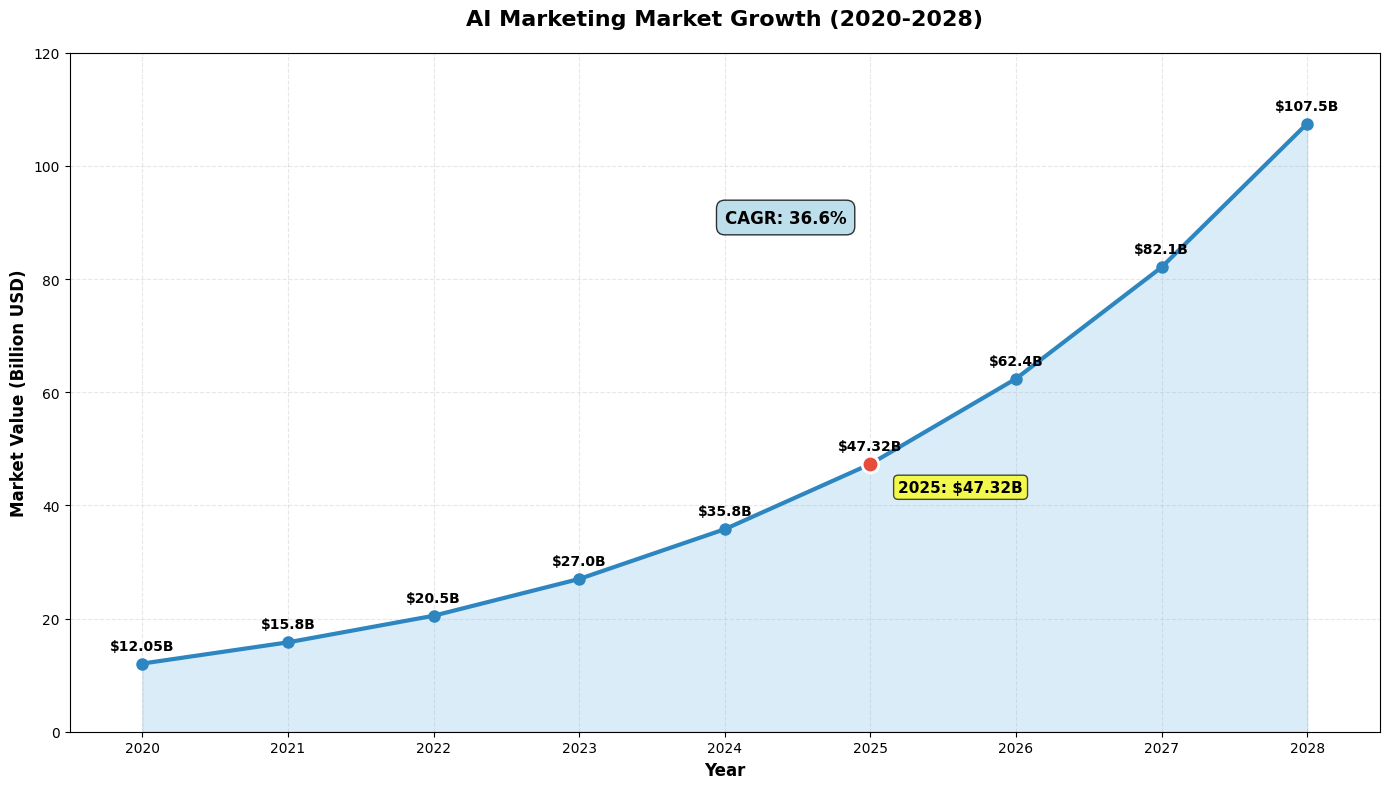
Artificial Intelligence is fundamentally transforming the marketing landscape in 2025, with the AI marketing market reaching $47.32 billion and growing at an unprecedented 36.6% CAGR.
This comprehensive analysis reveals that 88% of marketers now use AI daily, achieving average ROI of 300% while reducing customer acquisition costs by 37%. Key findings include 95% of customer interactions becoming AI-powered by 2025, 80% reduction in content production time, and 30% of marketing messages being AI-generated by large organizations.
1. AI Marketing Market Size & Explosive Growth
The AI marketing industry has experienced explosive growth, expanding from $12.05 billion in 2020 to $47.32 billion in 2025 – a staggering 293% increase in just five years. This growth trajectory shows no signs of slowing, with projections indicating the market will reach $107.5 billion by 2028, representing a compound annual growth rate (CAGR) of 36.6%.
Key Insight: The global generative AI market alone is valued at $62.75 billion in 2025 and is expected to grow to $356.05 billion by 2030 at a CAGR of 41.52%, indicating that marketing represents a significant portion of overall AI adoption.
2. Marketing Team Adoption Rates Surge
Marketing professionals have embraced AI at unprecedented rates. Current data shows that 88% of digital marketers use AI in their day-to-day tasks, while 92% of businesses intend to invest in generative AI tools over the next three years. The adoption breakdown reveals:
- 56% of companies are actively using AI marketing tools
- 29% plan to adopt AI technologies in the near future
- 43% are in the experimentation phase with AI
- Only 9.5% have no plans to implement AI
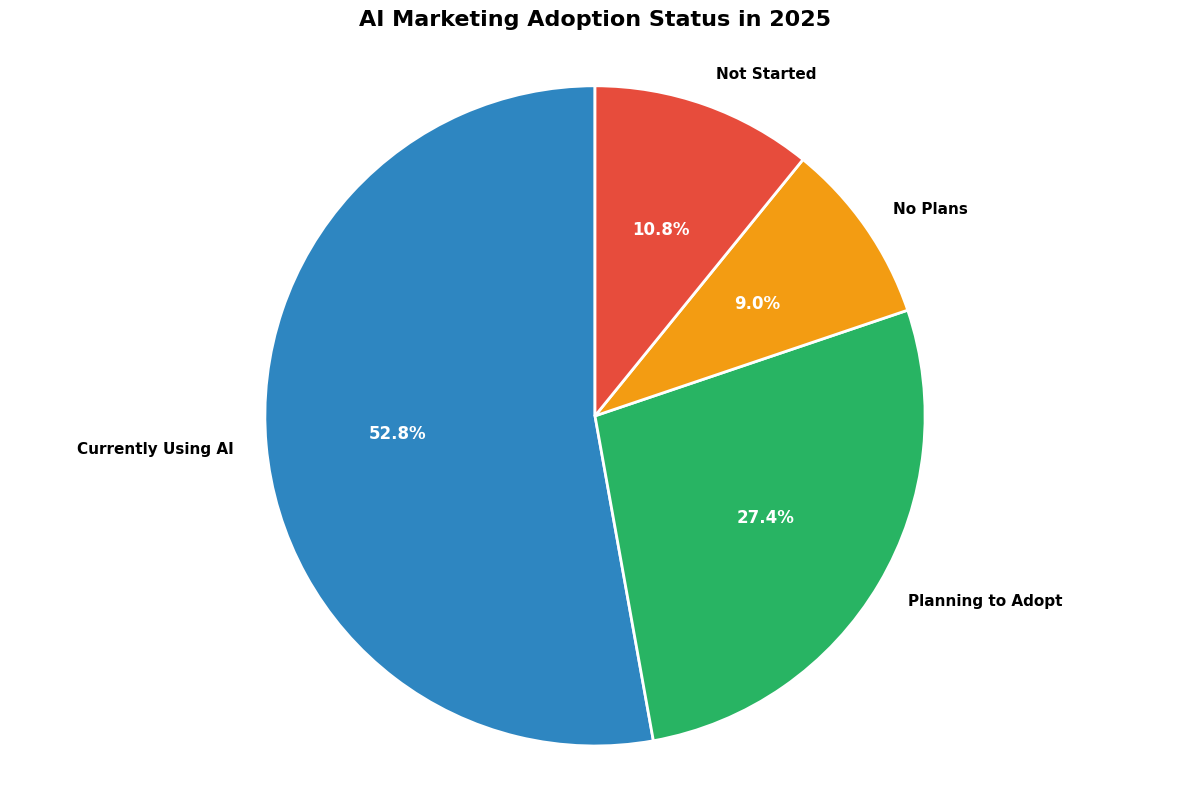
AI Marketing Adoption Status in 2025: Distribution of current adoption levels across organizations.
Key Insight: 91.5% of world-leading businesses like Google, Pfizer, and General Motors have invested in AI technologies, setting the standard for competitive advantage in marketing.
Related: Top 150+ Customer service statistics & Trends [2025]
3. ROI and Revenue Impact: The 300% Return
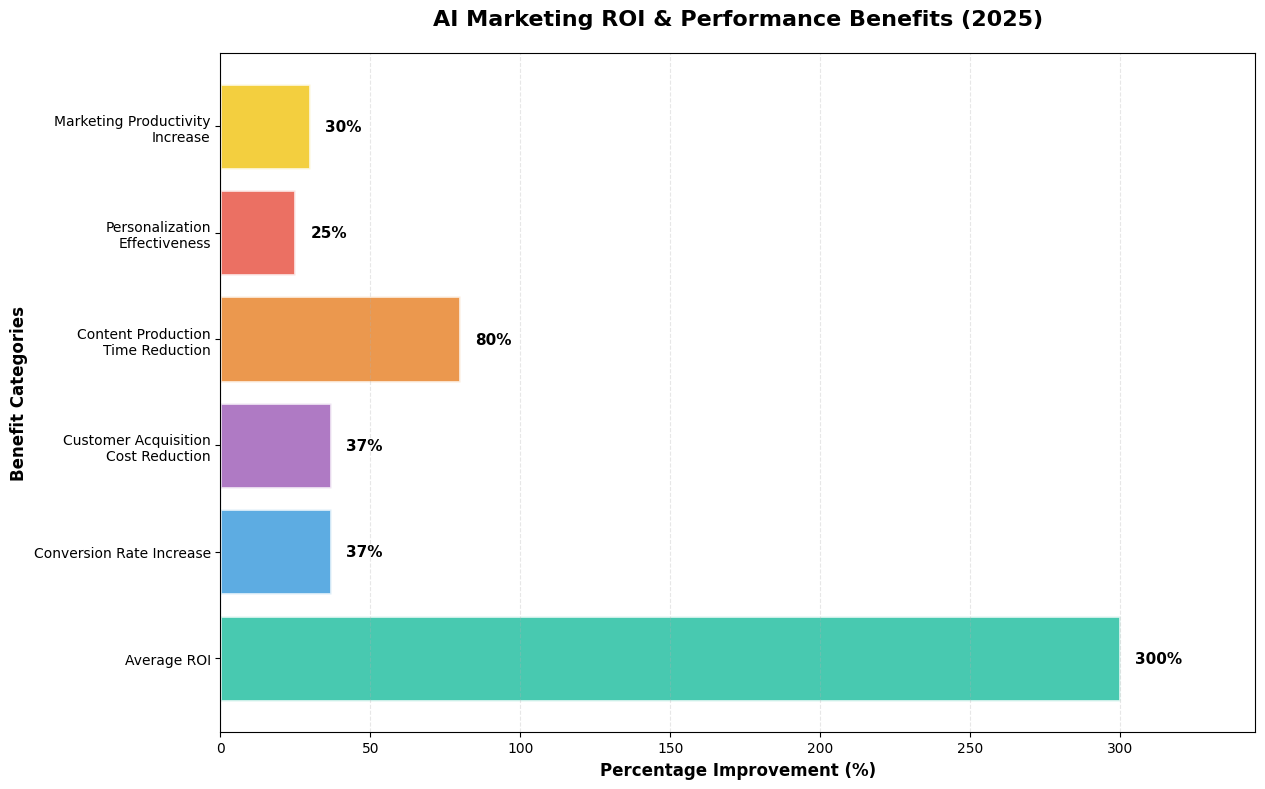
The financial impact of AI marketing tools is undeniable. Marketing teams implementing AI solutions see an average ROI of 300%, according to recent industry analysis. Organizations investing deeply in AI see sales ROI improve by 10-20% on average, with leading implementations achieving even higher returns.
Specific revenue impacts include:
- 37% higher conversion rates through AI-powered targeting
- 37% reduction in customer acquisition costs
- 25% increase in average order values through AI recommendations
- $300,000+ annual cost savings for comprehensive implementations
4. AI-Powered Personalization Revolution
Personalization powered by AI has become a customer expectation rather than a luxury. 71% of consumers expect personalized interactions from brands, and 80% show greater likelihood to purchase when these expectations are met. The results speak volumes:
- Personalized emails generate 6x higher transaction rates (Experian)
- 40% more revenue for companies using AI personalization vs. slower-growing competitors
- 15-20% increase in conversion rates through personalized experiences
- 20% higher retention rates for customers receiving personalized experiences
Key Insight: Companies using AI-powered marketing strategies report 37% higher conversion rates and 52% better customer acquisition costs compared to traditional methods.
5. Content Generation: 80% Time Reduction
93% of marketers use AI to generate content faster, achieving remarkable efficiency gains. AI tools dramatically shrink content production timelines, with leveraging AI for content creation reducing production timelines by 80%. What once took days now requires just minutes to complete.
Performance metrics for AI-generated content show:
- 30% higher engagement rates on average
- 25% increase in pages indexed by search engines
- 36% higher conversion rates on landing pages
- 90% of content marketers planning to adopt AI by end of 2025
Related: 110 Excellent Customer Service Quotes for Business
6. Marketing Automation Efficiency Gains
Marketing automation powered by AI delivers substantial productivity improvements. AI can increase marketing productivity by 5-15% of total marketing spending, with teams reporting they can reallocate nearly 30% of their time toward strategic initiatives when automation handles routine work.
Specific efficiency improvements include:
- 40-60% reduction in campaign setup time
- 20-30% reduction in campaign production costs
- 15-25% decrease in customer acquisition expenses
- 64% of marketers already use automation and AI in daily operations
7. Customer Service Chatbots Dominance
The chatbot revolution is reshaping customer service. 95% of customer interactions are expected to be AI-powered by 2025, with the AI chatbot market reaching $27.29 billion by 2030, growing at 23.3% annually.
Current adoption and performance metrics:
- 80% of companies are using or planning to adopt AI-powered chatbots
- 87.2% rate chatbot interactions as positive or neutral
- $8 billion in savings expected from chatbot cost reductions
- 148-200% ROI achieved by leading chatbot implementations
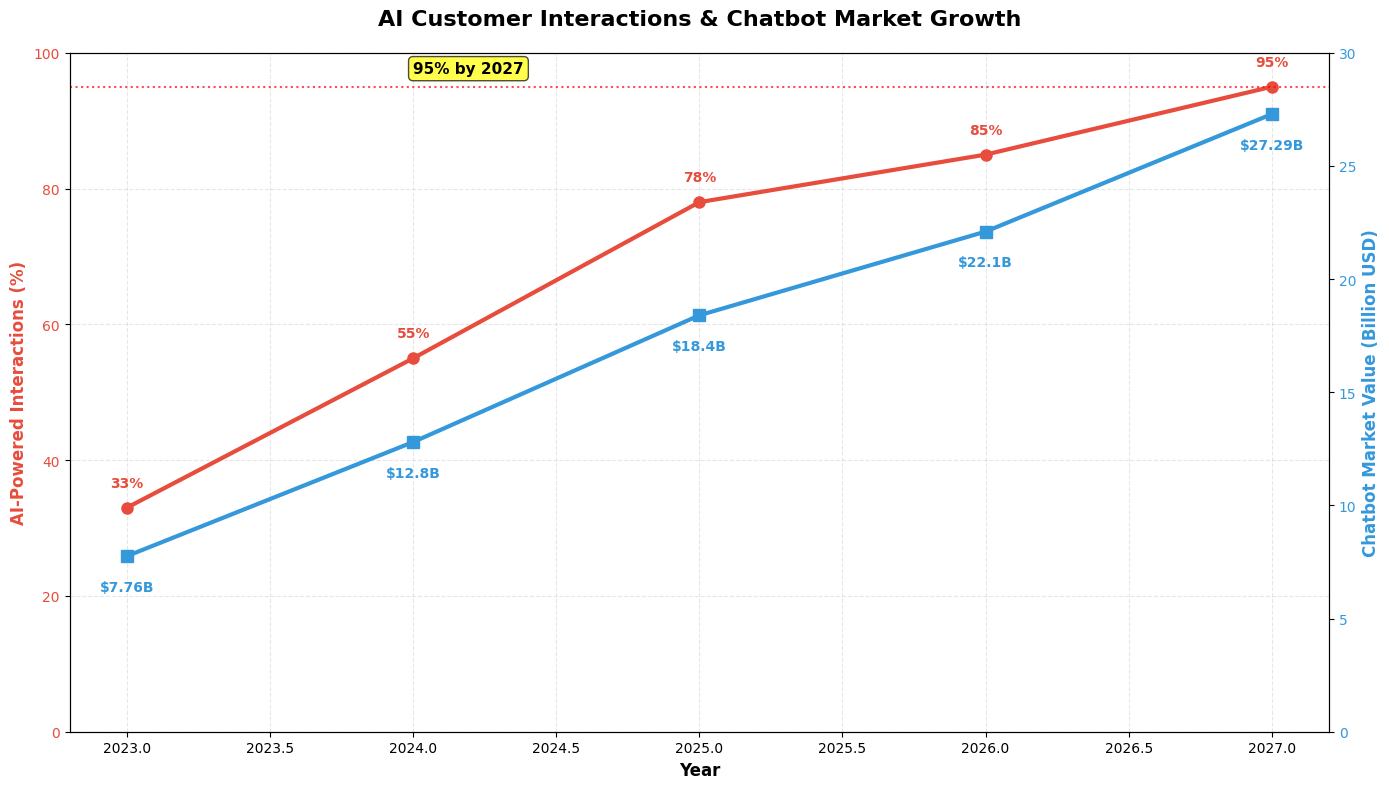
AI Customer Interactions & Chatbot Market Growth: Dual-axis chart showing the correlation between AI interaction adoption and market value growth through 2027.
8. Predictive Analytics Performance Leap
AI-powered predictive analytics is transforming marketing precision. Companies using AI for customer targeting report 25% improvement in targeting accuracy and 74% of leading performance agencies use machine learning for processing data signals to better understand consumer intent.
Key predictive analytics benefits:
- 50% of agencies reallocate 30% of time to strategic activities through AI
- 42% of businesses leverage AI tools to automate processes and minimize costs
- 85% of company executives believe AI will help obtain competitive edge
9. AI Agent Integration: The Future is Now
19.65% of marketers plan to use AI agents to automate marketing in 2025, representing the next evolution in AI marketing technology. By 2026, 40% of enterprise applications will feature task-specific AI agents, up from less than 5% in 2025.
AI agent capabilities expanding rapidly:
- Visual interface navigation and action-taking within applications
- Real-time learning and adaptation without explicit retraining
- Complex reasoning capabilities for multi-step workflows
- Autonomous decision-making with human oversight
10. Future Predictions & Emerging Trends
Looking ahead, 30% of outbound marketing messages from large organizations will be AI-generated by 2025. Additional future predictions include:
- 30% of work hours may be automated by 2030 using AI (McKinsey)
- 25% decrease in search engine volume by 2026 due to AI chatbots
- 40% of generative AI solutions will be multimodal by 2027
- $80 billion reduction in contact center labor costs by 2026
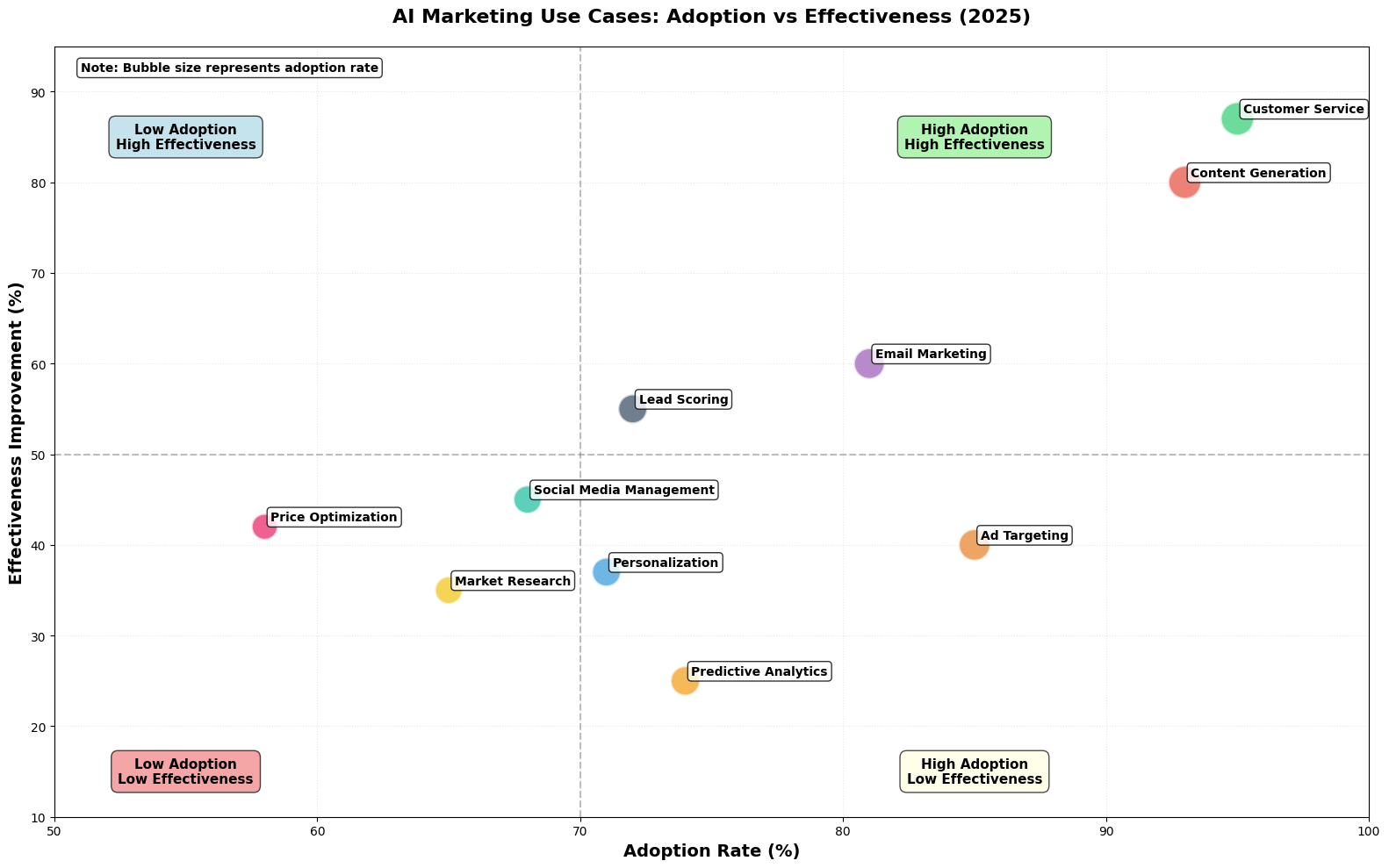
Key Takeaways for Marketing Leaders
- Market Opportunity: The $47.32B AI marketing market growing at 36.6% CAGR presents massive opportunities for early adopters
- Competitive Advantage: 88% adoption rate means AI is now table stakes, not optional
- ROI Potential: 300% average ROI with 37% cost reduction makes AI marketing highly profitable
- Customer Expectations: 71% expect personalization; 95% of interactions will be AI-powered
- Efficiency Gains: 80% time reduction in content creation enables strategic focus
- Future-Ready: AI agents and multimodal AI represent the next competitive frontier
Read Also: 200+ Chatbot Names and Ideas to Give Your Next Bot
Conclusion: The AI Marketing Imperative
The statistics paint a clear picture: AI marketing is not just a trend but a fundamental shift in how businesses connect with customers. With 88% of marketers already using AI daily and achieving 300% ROI, the question is no longer whether to adopt AI, but how quickly you can implement it effectively.
Action Steps for Marketing Teams:
- Audit current AI readiness and data infrastructure
- Start with high-impact, low-complexity use cases like content generation and email personalization
- Invest in team training as 66% of leaders believe teams lack necessary AI skills
- Measure and optimize using the key performance indicators outlined in this analysis
- Plan for AI agents and multimodal AI to stay ahead of the 2026-2027 adoption wave
The companies that master AI marketing today will dominate the markets of tomorrow. The statistics show the path forward – now it is time to take action.
Sources & References
This analysis is based on comprehensive research from leading industry sources including:
- McKinsey & Company – The State of AI Reports (2024-2025)
- Gartner – AI Predictions and Market Analysis (2025)
- Statista – AI Marketing Revenue and Growth Statistics
- Grand View Research – Global AI Chatbot Market Analysis
- Salesforce – AI Marketing Statistics and Trends
- SurveyMonkey – Marketing Professional AI Usage Research
- HubSpot – Marketing Statistics and Automation Trends
- SEO.com – Comprehensive AI Marketing Statistics Report
- Cubeo AI – ROI Analysis and Implementation Studies
- OpenAI – AI Agent Capabilities and Future Predictions
