

Chatbot Automation: What it is & How it Works
Chatbot automation is reshaping the way businesses deliver instant, efficient, and personalized customer interactions. By combining the power of artificial intelligence with smart process flows, chatbot automation streamlines communication, boosts customer satisfaction, and frees up valuable human resources for more complex tasks. Whether you’re enhancing support services, driving sales, or improving internal operations, chatbot automation transforms how organizations connect and engage — faster, smarter, and better.
What is Chatbot Automation?
Chatbot automation refers to the process of developing and deploying AI-powered conversational interfaces that can interact with users without human intervention. These intelligent systems use natural language processing (NLP), machine learning algorithms, and predefined rules to understand user queries, provide relevant responses, and perform various tasks automatically.
Unlike traditional chatbots that followed simple if-then logic, modern automated chatbots can learn from interactions, adapt to different scenarios, and deliver increasingly personalized experiences.
How Chatbot Automation Works
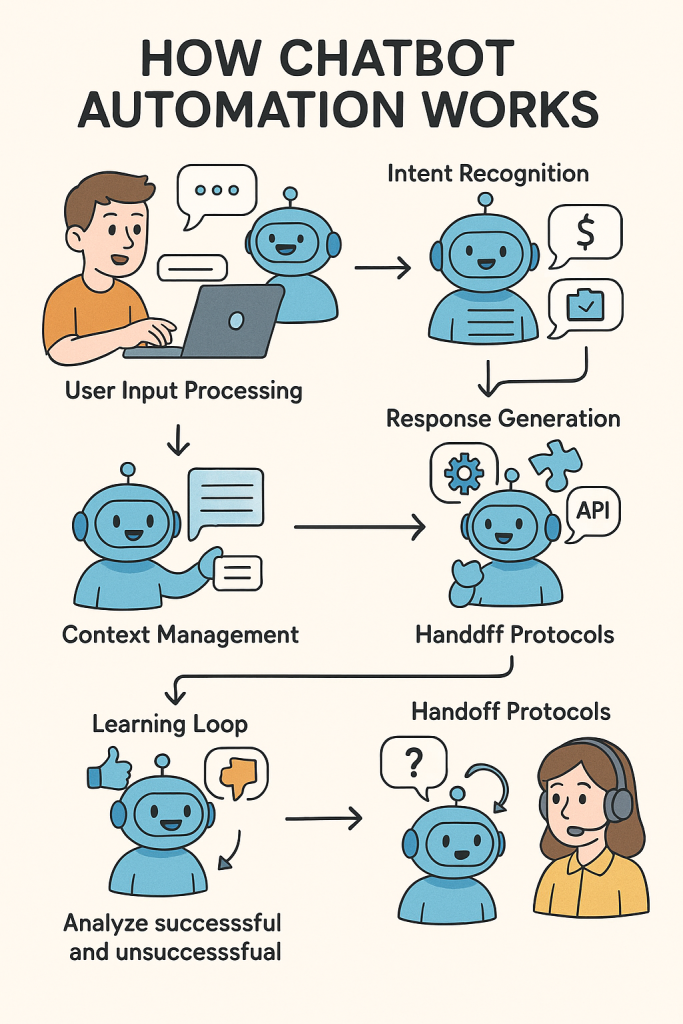
Chatbot automation functions through a sophisticated process flow:
- User Input Processing: When a user sends a message, the chatbot’s NLP engine analyzes the text to identify intent, entities, and sentiment.
- Intent Recognition: The system determines what the user is trying to accomplish (e.g., track an order, get product information, schedule an appointment).
- Context Management: The chatbot maintains conversation history to understand follow-up questions and provide contextually relevant responses.
- Response Generation: Based on the identified intent and available data, the chatbot formulates an appropriate response by accessing its knowledge base or connected systems.
- Action Execution: If the intent requires an action (like checking inventory or updating account details), the chatbot interacts with the relevant business systems via APIs.
- Learning Loop: Advanced chatbots analyze successful and unsuccessful interactions to improve response accuracy over time.
- Handoff Protocols: When the chatbot detects a query beyond its capabilities, it smoothly transfers the conversation to a human agent with relevant context.
This automation process happens in milliseconds, creating the seamless conversational experience that users expect while handling thousands of interactions simultaneously.
Key Components of Chatbot Automation
- Natural Language Processing (NLP): The technology that enables chatbots to understand human language, interpret intent, and respond appropriately.
- Machine Learning: Allows chatbots to improve over time by learning from past interactions and user feedback.
- Dialogue Management: Systems that maintain context throughout conversations, ensuring coherent and meaningful exchanges.
- Integration Capabilities: APIs and connectors that link chatbots to various business systems like CRM, inventory management, or payment gateways.
- Analytics Dashboard: Tools that track chatbot performance, user satisfaction, and conversion metrics.
Benefits of Implementing Chatbot Automation
Cost Efficiency
Automated chatbots can handle thousands of customer interactions simultaneously, reducing the need for large customer service teams and cutting operational costs significantly. Research shows that businesses can save up to 30% on customer support costs through effective chatbot implementation.
24/7 Availability
Unlike human agents who require breaks and work specific hours, automated chatbots provide round-the-clock service. This constant availability ensures that customer queries are addressed promptly regardless of time zones or holidays.
Scalability
During peak seasons or promotional campaigns when customer inquiries surge, chatbots can easily handle the increased volume without additional resources or compromising on response times.
Consistent Customer Experience
Human agents may have varying levels of knowledge, patience, or communication skills. Automated chatbots deliver consistent information and maintain the same tone across all interactions, ensuring a uniform brand experience.
Popular Applications of Chatbot Automation
Customer Service
Automated chatbots excel at handling common customer queries, processing returns, tracking orders, and providing product information. They can resolve straightforward issues instantly while seamlessly escalating complex cases to human agents when necessary.
Lead Generation and Sales
Chatbots can qualify leads by asking relevant questions, recommend products based on customer preferences, and guide users through the purchase process. They can also send personalized promotions and re-engage potential customers who abandoned their shopping carts.
Internal Operations
Beyond customer-facing roles, chatbots streamline internal processes by assisting employees with HR queries, IT support, and accessing company information.
Healthcare
In healthcare settings, automated chatbots help with appointment scheduling, medication reminders, symptom assessment, and providing general health information.
Essential Features to Look for in Automated Chatbot Software
When evaluating chatbot automation solutions for your business, consider these critical features that separate premium offerings from basic options:
1. Advanced NLP Capabilities
Look for platforms with sophisticated natural language processing that can handle:
- Multiple languages and regional dialects
- Misspellings and grammatical errors
- Contextual understanding across multi-turn conversations
- Entity recognition for extracting specific information from user queries
- Sentiment analysis to detect user emotions and adjust responses accordingly
2. Omnichannel Deployment
Choose software that allows your chatbot to function seamlessly across:
- Website chat widgets
- Mobile apps
- Social media platforms (Facebook Messenger, WhatsApp, Instagram)
- SMS/text messaging
- Voice assistants and IVR systems
- Email integration
3. No-Code or Low-Code Interface
Prioritize platforms that offer:
- Visual conversation builders for easy workflow design
- Drag-and-drop interfaces for creating dialogue paths
- Template libraries for common use cases
- User-friendly testing and deployment options
- Minimal reliance on developer resources for updates
4. AI Learning & Adaptation
Select software with AI capabilities that enable:
- Continuous learning from past interactions
- Automated improvement of response accuracy over time
- Suggestion of new conversation flows based on user behavior
- A/B testing of different response strategies
- Identification of knowledge gaps requiring attention
5. Seamless Human Handoff
Ensure the platform provides:
- Intelligent escalation triggers when AI can’t adequately resolve an issue
- Complete conversation history transfer to human agents
- Real-time agent availability monitoring
- Chat routing based on agent expertise or department
- Smooth transition back to automated assistance when appropriate
6. Robust Analytics & Reporting
Valuable insights come from platforms offering:
- Comprehensive dashboards with key performance metrics
- Conversation funnel analysis and drop-off points
- User satisfaction scoring
- Query categorization and trend identification
- Custom report generation for different stakeholders
7. Enterprise-Grade Security
Verify that the software includes:
- End-to-end encryption for all conversations
- Compliance with relevant regulations (GDPR, HIPAA, etc.)
- Data anonymization options
- Role-based access controls
- Regular security audits and updates
8. Extensive Integration Capabilities
The platform should connect easily with:
- CRM systems (Salesforce, HubSpot, etc.)
- E-commerce platforms
- Payment processors
- Knowledge bases and content management systems
- Customer service software
- Marketing automation tools
9. Personalization Engine
Effective personalization requires features like:
- User profile creation and maintenance
- Behavior-based recommendation algorithms
- Personalized greeting and conversation flows
- Custom variables for dynamic content insertion
- Preference-based response tailoring
10. Scalability & Performance
Ensure the solution can:
- Handle peak traffic periods without degradation
- Scale instantly to accommodate business growth
- Manage thousands of simultaneous conversations
- Maintain consistent response times under load
- Offer geographic redundancy and failover options
Best Practices for Successful Chatbot Automation
Define Clear Objectives
Before implementing chatbot automation, establish specific goals such as reducing support tickets by a certain percentage, increasing conversion rates, or improving response times.
Focus on User Experience
Design conversational flows that feel natural and intuitive. Avoid overwhelming users with too many options or complex language.
Plan for Human Handoff
Create smooth transition protocols for when a conversation needs to be transferred from the chatbot to a human agent.
Continuous Improvement
Regularly analyze chatbot interactions, identify patterns of confusion or failure, and refine the system accordingly.
Related: Chatbot types: [Classification & Categories]
Challenges and Limitations
Understanding Context
Despite advances in NLP, chatbots sometimes struggle with complex linguistic nuances, sarcasm, or culturally specific expressions.
Managing User Expectations
Users may have unrealistic expectations about a chatbot’s capabilities, leading to frustration when the bot can’t solve certain problems.
Security and Privacy Concerns
As chatbots collect and process user data, ensuring compliance with privacy regulations and maintaining data security becomes crucial.
The Future of Chatbot Automation
Multimodal Capabilities
Future chatbots will increasingly incorporate voice, visual, and text interactions, creating more immersive and accessible user experiences.
Emotional Intelligence
Advancements in sentiment analysis will enable chatbots to recognize and respond appropriately to user emotions, making interactions more empathetic.
Proactive Engagement
Rather than waiting for user inquiries, next-generation chatbots will anticipate needs based on behavior patterns and initiate relevant conversations.
Conclusion
Chatbot automation represents a significant leap forward in how businesses engage with customers and streamline operations. When implemented thoughtfully, automated chatbots can deliver substantial returns on investment while enhancing user satisfaction.
As AI technologies continue to evolve, the capabilities and applications of chatbot automation will expand, further cementing its role as an essential tool in the modern business landscape.
