

AI Helpdesk Management; All you need to know in 2026
If you have ever opened your support dashboard on a Monday morning only to find hundreds of unread messages waiting for you, then you know exactly why businesses are moving toward AI helpdesk management.
It is a very common frustration for growing brands; the more successful you become, the more tickets you receive, and suddenly your team is spending all their time “sorting” problems instead of “solving” them.
This “support debt” is a massive pain point that leads to slow response times, unhappy customers, and a team that feels like they are constantly drowning in a sea of repetitive questions. You want a system that stays organized even when you’re sleeping, allowing you to focus on the big picture of your business.
In this article, we are going to explore the mechanics of how artificial intelligence organizes your workspace, the detailed steps involved in managing a digital helpdesk, and why the best modern solutions are moving beyond simple “ticketing” and into the world of sales intelligence.
What is AI Helpdesk Management?
AI helpdesk management is the use of smart software to oversee, organize, and resolve customer support inquiries automatically. Instead of a human being having to read every single email to decide if it’s a “billing issue” or a “technical bug,” the AI does the heavy lifting for you.
It acts as the “air traffic controller” for your business, making sure every message goes to the right place and gets the right answer in the shortest amount of time.
It is about moving from a reactive state—where you are always playing catch-up—to a proactive state where your technology handles the routine work. This doesn’t mean you are losing the human touch; it means you are freeing up your human team to handle the high-stakes conversations that truly require empathy and complex problem-solving.
A well-managed AI helpdesk turns your support department from a cost-heavy “burden” into a high-speed engine that protects your brand’s reputation 24/7.
How AI Helpdesk Management Works
The process of managing a digital helpdesk involves a sophisticated cycle of understanding, retrieving information, and taking action. Here is a detailed look at how this intelligence actually functions:
Phase 1: Intelligent Ticket Categorization and Routing
Everything begins the moment a message arrives from a customer. The AI uses Natural Language Processing (NLP) to read the message and understand the “intent” behind it. Instead of just looking for keywords, it analyzes the tone and the specific problem the user is facing.
It then automatically “tags” the ticket and routes it to the correct department or assigns it to an AI agent for immediate resolution. This phase is critical because it eliminates the hours of manual sorting that usually slow down support teams, ensuring that urgent issues are prioritized and simple questions are handled instantly.
Phase 2: Contextual Knowledge Retrieval and Thinking
Once the AI understands the question, it goes into its “brain”—which is your company’s knowledge base, website, and past interaction history. It “thinks” about the best possible solution by comparing the current inquiry to thousands of previous successful resolutions.
It doesn’t just give a generic answer; it pulls in contextual data, such as the customer’s purchase history or their specific location, to craft a personalized response. This layer of the software ensures that the helpdesk isn’t just fast, but is also accurate and helpful, providing a level of service that feels like it came from a seasoned expert who knows your business inside and out.
Phase 3: Automated Resolution and Sentiment Tracking
The final phase is the execution of the answer and the monitoring of the customer’s reaction. The AI sends the response and then “listens” to see if the customer is satisfied. If the user’s tone becomes frustrated or if the question is too complex, the management system automatically triggers a “human handoff,” alerting a live agent to step in with the full history of the chat.
This constant tracking of “sentiment” ensures that the quality of your support remains high. It also creates a feedback loop where the AI learns from every interaction, getting smarter and more efficient with every ticket it manages.
Why Salesgroup is the Premier Choice for Helpdesk Management
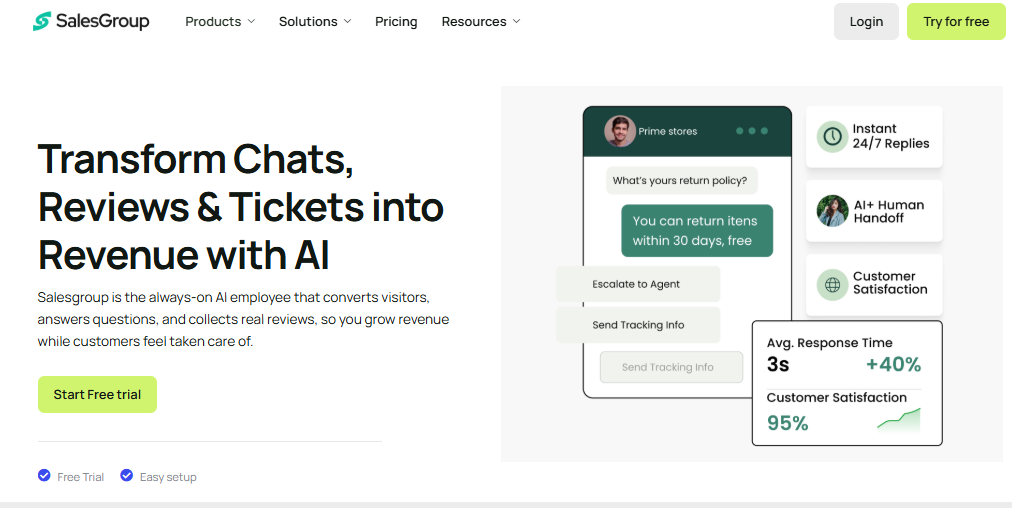
While most helpdesk tools are just digital storage boxes for messages, Salesgroup is a full-scale AI Sales and Support Ecosystem designed to manage your growth. It is built for the business owner who wants to stop “handling” tickets and start “closing” opportunities.
Salesgroup combines AI Agents, Live Chat, Reviews, and Push Notifications into one unified workspace, ensuring that every customer interaction is managed with the goal of increasing your revenue.
The reason Salesgroup is superior for AI helpdesk management is because it bridges the gap between support and sales. When a customer reaches out with a question, Salesgroup’s AI doesn’t just resolve the issue; it identifies “buying signals.” It can suggest products, show social proof through the Reviews Platform, and keep the customer engaged long after the ticket is closed.
By choosing Salesgroup, you are replacing a “passive helpdesk” with an “active sales partner” that ensures your brand is winning on every platform, including your website, Facebook, and Instagram.
Key Metrics for Successful AI Helpdesk Management
To ensure your automated helpdesk is actually helping your business grow, you should monitor these specific metrics within your dashboard:
1. Goal Completion Rate (GCR)
The Goal Completion Rate is the most important indicator of your helpdesk’s intelligence. it represents the percentage of customer inquiries that the AI was able to resolve from start to finish without a human agent ever having to intervene.
A high GCR means your AI helpdesk management is working perfectly, saving you thousands of dollars in labor costs and providing your customers with the instant gratification they crave. It proves that your system is well-trained and capable of handling the heavy lifting of your daily support volume.
2. Human-Hours Reclaimed
This metric tracks the total volume of time your staff has saved because the AI handled the repetitive and boring tasks for them. Instead of spending their day answering “Where is my order?” fifty times, your team can spend their time on high-level strategy, complex problem-solving, and closing high-value deals.
Reclaiming these hours is a massive win for your ROI because it allows you to scale your business and handle ten times the volume of customers without needing to hire a massive team or increase your monthly payroll.
3. First Response Time (FRT)
In 2026, speed is the ultimate competitive advantage. This metric measures exactly how many seconds it takes for a user to receive their first helpful response. An AI-managed helpdesk aims for near-instant replies, which prevents customers from getting frustrated and bouncing to a competitor.
By keeping your FRT as low as possible, you are building immediate trust and ensuring that the momentum of a potential sale stays alive. It shows your customers that you value their time as much as they do.
4. Resolution Sentiment Score
This goes beyond a simple “thumbs up” or “thumbs down.” It uses AI to analyze the customer’s final message to see if they feel positive, neutral, or negative about the experience. Tracking sentiment allows you to identify if your AI is being too robotic or if your help articles need to be updated.
It gives you a “human” view of your automated systems, ensuring that your helpdesk management isn’t just about speed, but also about the quality of the relationship you are building with every person who contacts your brand.
Conclusion
The era of manual, slow-moving support is ending. To thrive in a digital world, you must have a system that is organized, intelligent, and focused on growth.
By mastering AI helpdesk management, you are turning a major business challenge into your greatest strength. You are giving your customers the instant answers they expect and your team the freedom they need to innovate and sell.
If you are ready to stop managing “complaints” and start managing “growth,” then you should sign up on Salesgroup today or try the free version before the day ends. It is time to let your technology handle the hard work so you can focus on the big picture.
