
Chatbot ROI: What it is & Metrics to Measure in 2026
Here is how knowing what chatbot ROI to look at can help improve the effectiveness of your AI agents.
When you stop looking at your website as a static page and start seeing it as a live sales floor, the math changes completely. The frustration of missing a “hot lead” because you were in a meeting or asleep is a silent killer of growth that leads to wasted ad spend and stagnant revenue.
In this article, we are going to explore the concept of “Opportunity Value,” the technical steps used to calculate the real return on your investment, and why the most successful brands are moving toward sales-focused intelligence in 2026.
What is Chatbot ROI?
In simple, human terms, Chatbot ROI is the measurable profit your business gains after subtracting the cost of the automation software. However, it goes much deeper than just “money in versus money out.” It is about the “Value of Opportunity”—the specific revenue generated when a digital assistant identifies a buyer, answers their objection, and closes a deal at 3:00 AM while you are fast asleep.
For a long time, businesses viewed chatbots as a way to “deflect” customers or keep them away from expensive human agents. Today, the conversation has shifted. True ROI is found when your bot stops acting like a gatekeeper and starts acting like a high-performing salesperson. It is the difference between a tool that handles a “refund request” and a tool that suggests a “related product” that increases the average order value. When your automation works correctly, it doesn’t just save you pennies on support; it earns you dollars on sales.
Related: 10 Common Customer Service Mistakes to Avoid
How the Chatbot ROI Calculation Works
Calculating the return on an AI investment requires looking at three distinct layers of your business. It is a detailed process that turns “feelings” into “facts.” Here is how that calculation unfolds:
Step 1: The Cost Displacement Phase (Operational Savings)
Everything begins with measuring the “Human-Hours” saved. In this phase, you calculate the cost of a human agent handling a single ticket—including their salary, benefits, and the time spent on repetitive tasks like “Where is my order?” If a human costs $25 per hour and handles five tickets, each ticket costs $5.
If an AI agent can handle 80% of those tickets instantly for a fraction of a cent, that “saved cost” is your first layer of ROI. This phase is about efficiency; it ensures your human team is only spending their expensive time on complex, high-value problems that truly require a person’s touch, effectively slashing your operational overhead overnight.
Step 2: The Revenue Attribution Layer (Direct Sales & Lead Gen)
This is where the calculation becomes much more interesting for growth-minded owners. This layer tracks the “Assisted Revenue”—sales that happened because the chatbot engaged the visitor at a critical moment. For example, if a visitor is on your pricing page and looks confused, the AI can trigger a message offering a discount or a product comparison.
If that visitor then completes a purchase, that revenue is directly attributed to the bot’s intervention. By measuring the conversion rate of “chatted visitors” versus “non-chatted visitors,” you can see exactly how much extra money the automation is putting into your bank account that would have otherwise been lost to abandoned carts.
Step 3: The Customer Lifetime Value (CLV) Multiplier
The final and most powerful step in the ROI calculation is the long-term impact on customer loyalty. Fast response times are the number one driver of customer satisfaction in 2026.
When a customer gets an answer in three seconds instead of three hours, they are significantly more likely to return for a second or third purchase. In this phase, you calculate the “Retention Lift.” By providing instant support and personalized recommendations, the AI increases the total value of each customer over their entire relationship with your brand. This multiplier effect means that a $50 sale today could turn into $500 of revenue over the next year, all because the initial interaction was handled perfectly by your automated system.
Why Salesgroup is the Premier Choice for Maximizing ROI
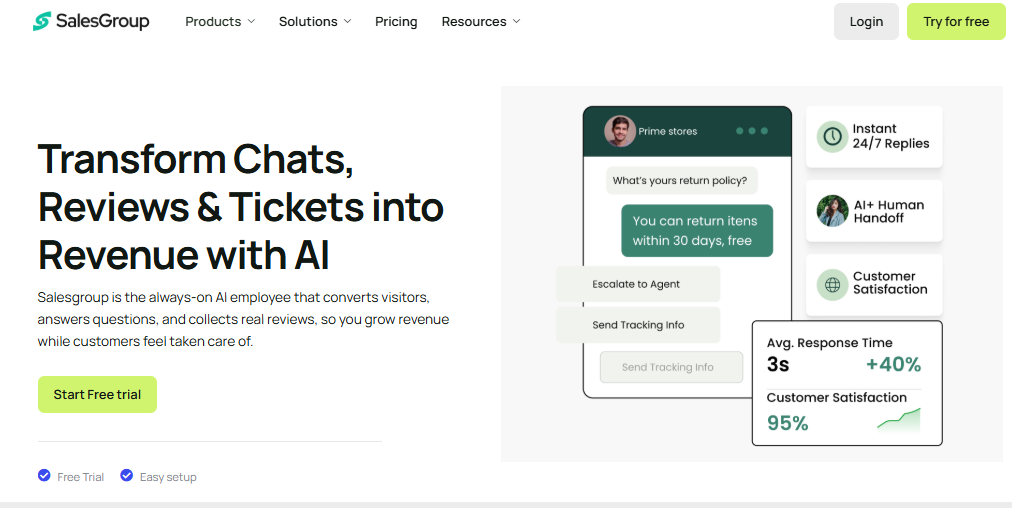
While many basic bots are content with just being “helpful,” Salesgroup is built with a “Sales-First” architecture that is designed specifically to maximize your ROI. It doesn’t just wait for questions; it proactively looks for buying signals. Salesgroup provides a complete ecosystem that includes AI Agents, Live Chat, Reviews, and Push Notifications that all work together to move the needle on your revenue.
The reason Salesgroup delivers a higher return than support-only tools is because it treats every interaction as an opportunity to grow. It uses your store’s data to suggest the right products to the right people at the right time. Furthermore, it integrates a Reviews Platform to build the social proof needed to close a deal directly in the chat window.
By choosing Salesgroup, you aren’t just buying a “support tool”; you are investing in a 24/7 sales engine that works across your website, Facebook, and Instagram to ensure no lead ever goes cold.
Key Metrics to Track for Your Business
To ensure your automation is actually paying for itself, you should keep an eye on these specific metrics within your dashboard. Each of these represents a different way that AI adds value to your bottom line:
1. Goal Completion Rate (GCR)
The Goal Completion Rate is one of the most important numbers to watch because it tells you exactly how effective your AI is at solving problems without human help. A high GCR means that your customers are getting their answers immediately and leaving the conversation satisfied, rather than being “passed off” to a human agent who might not be available for several hours.
When your GCR increases, your automation efficiency goes up, which directly reduces the cost per ticket. It proves that your “business brain” is well-trained and capable of handling the heavy lifting of customer support, allowing your human team to stay focused on high-stakes projects.
2. Lead Conversion Rate
This metric measures the percentage of website visitors who provide their contact information or book a meeting through the chatbot app. In the world of e-commerce and digital sales, your traffic is only valuable if it turns into a relationship, and a high-performing AI agent acts as a proactive filter that catches “warm” leads before they leave your site.
By engaging users the moment they show interest, the bot moves them from being “anonymous browsers” to “qualified prospects.” A strong lead conversion rate demonstrates that your chatbot is successfully acting as a 24/7 sales assistant, ensuring that your marketing budget is resulting in real revenue opportunities.
3. Average Order Value (AOV) Lift
AOV Lift tracks the increase in total spending that occurs when a customer interacts with your AI’s personalized product recommendations. Unlike a simple support tool, a sales-focused platform like Salesgroup uses data to suggest relevant “add-ons” or premium versions of products that the customer is already looking at.
This is a massive driver of ROI because it increases the profit of every single transaction without you having to spend a single extra penny on advertising. When a bot can intelligently upsell a customer by explaining the benefits of a better product, it transforms your chat window into a high-converting digital sales floor.
4. Response Time (Speed to Lead)
In the modern digital world, speed is the number one driver of customer trust and completed sales. This metric tracks how many seconds it takes for your bot to give a helpful, accurate first reply. Ideally, you want this to be under five seconds because modern consumers expect instant gratification; if they have to wait more than a minute, they are highly likely to close the tab and find a competitor.
By providing a lightning-fast response time, you are removing the “friction” that usually stops a purchase. This immediate engagement keeps the customer’s attention focused on your brand and prevents the “abandoned cart” syndrome that hurts so many growing businesses.
5. Human-Hours Reclaimed
Human-Hours Reclaimed is the metric that shows you the total amount of time your staff has saved because the AI handled the repetitive, boring tasks for them. This isn’t just about saving money on salaries; it is about the “opportunity cost” of your team’s time. When your best employees aren’t stuck answering “Where is my order?” fifty times a day, they can focus on big-picture strategies, complex problem-solving, and building deep relationships with your VIP customers.
Reclaiming these hours allows you to scale your business and handle ten times the volume of customers without needing to hire a massive team, which is the ultimate key to sustainable growth.
Conclusion
The reality of modern business is that waiting to automate is costing you money every single hour. Every visitor who leaves your site with an unanswered question is a lost opportunity that lowers your overall profit. By understanding and tracking your Chatbot ROI, you can move from “guessing” to “growing” with total confidence.
If you are ready to stop seeing support as a “cost” and start seeing it as your biggest “profit center,” then you should sign up on Salesgroup today or try the free version before the day ends. It is time to let your technology start making you money while you focus on the big picture.
