

Squarespace vs Magento: Which is Best?
Squarespace vs Magento: Which is Best? Imagine you have a great product to sell. You’re excited, you’re ready, and now you need a website. You open your laptop, start searching, and suddenly you’re hit with a hundred options. It can feel like too much.
Two names that come up a lot are Squarespace and Magento. Maybe you’ve heard them before. Maybe a friend mentioned one, or you saw an ad. But what do they actually mean? Which one is for you? And do you even need either of them?
Don’t worry, we’re going to make this very simple. In this article, we will be breaking down what Squarespace and Magento are, how they are different, how they are similar, how much they cost, and which one might be the better choice for your business.
Let’s dive in.
What Is Squarespace?

Squarespace is a website builder. Think of it as a ready-made toolkit for building beautiful websites. You don’t need to know any coding. You don’t need to hire a developer. You just sign up, pick a template (a pre-designed layout), drag things around, add your photos and text, and your website is ready.
Squarespace was founded in 2003 and has grown into one of the most popular website platforms in the world. It is especially loved by creative people — photographers, artists, bloggers, small business owners, and people who sell handmade goods. If you want your website to look stunning without spending weeks learning how to build one, Squarespace is a very attractive option.
Squarespace is what is called an all-in-one platform. This means that your website hosting (the service that keeps your site live on the internet), your domain name, your templates, your online store tools, and your customer support are all managed in one place. You pay one monthly fee and Squarespace handles everything else in the background.
Some of the most popular features of Squarespace include its award-winning design templates, built-in blogging tools, email marketing features, simple inventory management, and an AI-powered website builder called Blueprint AI that helps you get started quickly. It also comes with SSL security (which makes your site safe for visitors), unlimited storage and bandwidth on all plans, and 24/7 customer support.
What Is Magento?
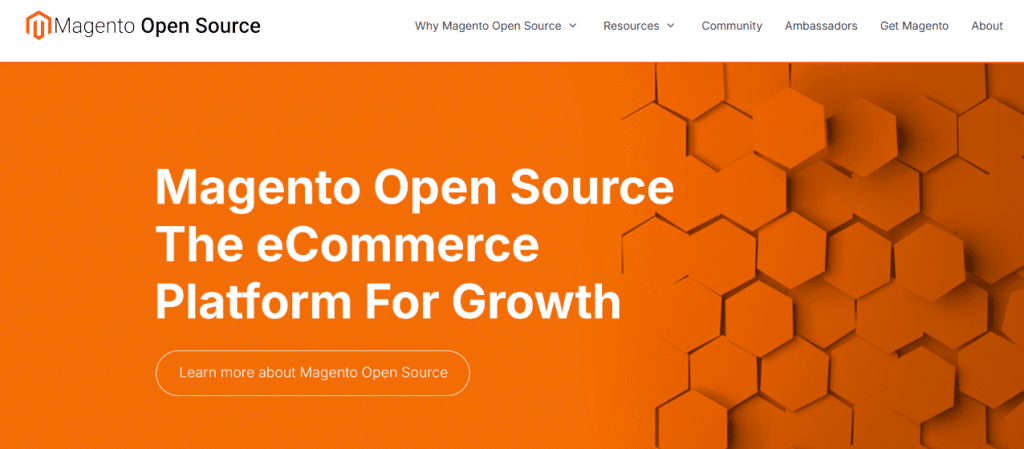
Magento is a completely different kind of platform. It is an open-source ecommerce software, which means the base version is free to download and the code is publicly available for anyone to modify. Magento was launched in 2008 and is now owned by Adobe, which renamed the premium version Adobe Commerce.
While Squarespace is built for beginners and creative professionals, Magento is built for large businesses and developers. To use Magento properly, you either need to know how to code yourself or hire a team of developers who do. Setting up a Magento store is not a weekend project — it can take months and cost tens of thousands of dollars by the time everything is up and running.
So why would anyone choose Magento? Because of power and flexibility. Magento can handle enormous product catalogues — we’re talking hundreds of thousands of products. It can manage multiple stores in different languages and currencies from one dashboard. It supports complex business-to-business (B2B) operations. It can be customised in almost unlimited ways. For a large company with complex needs, Magento is a serious tool.
There are two main versions of Magento. The first is Magento Open Source, which is free to download but comes with no hosting, no support, and limited features. The second is Adobe Commerce, which is the paid, enterprise-level product packed with advanced features like AI-powered product recommendations, customer segmentation, and built-in B2B tools.
Squarespace vs Magento? The Difference
The differences between these two platforms are significant. They are really built for completely different kinds of users.
1. Ease of use
This is perhaps the biggest difference. Squarespace is designed so that anybody can use it — no technical knowledge required. You can build a professional-looking website in a day. Magento, on the other hand, has a steep learning curve. Even experienced developers need time to learn how it works, and most businesses using Magento rely on a dedicated technical team to manage the platform.
2. Target audience
Squarespace is made for individuals, freelancers, small business owners, and creative entrepreneurs. Magento is made for mid-sized to large enterprises with complex ecommerce operations. If you’re selling 20 handmade candles, Squarespace is the right tool. If you’re running a global retail operation with 50,000 products in multiple languages, Magento might make more sense.
3. Customisation
Squarespace gives you a great deal of design flexibility within its templates, but there are limits. You can only build what the platform allows. Magento, being open-source, gives you complete freedom to build anything you want — but only if you have the technical expertise or the budget to hire someone who does.
4. Hosting and maintenance
With Squarespace, hosting is included in your monthly plan. You never have to worry about servers going down or software updates. With Magento Open Source, you are responsible for finding your own hosting, keeping your software updated, applying security patches, and fixing any technical problems that arise. This is a serious ongoing commitment of both time and money.
5. Scalability
This is where Magento pulls ahead. If you’re planning to grow your store to a very large size, Squarespace may eventually feel limiting. Magento is built to scale without performance issues, even with massive traffic and enormous product catalogues.
What Are the Similarities Between Squarespace and Magento?
Despite being so different, Squarespace and Magento do share some common ground.
Both platforms are built to help you sell products online. Whether you’re using Squarespace’s built-in store or a Magento-powered shop, both give you the tools to list products, manage inventory, process payments, and handle customer orders.
Both platforms offer SEO tools — features that help your website show up in Google search results. Squarespace includes basic SEO settings directly in its editor, while Magento provides more advanced SEO controls for those who need them.
Both also offer mobile-responsive designs, meaning that your website will look good and work properly on phones and tablets, not just desktop computers. This is important because a large portion of online shoppers browse and buy using their mobile devices.
Additionally, both platforms support a wide variety of payment methods. You can connect payment providers like PayPal, Stripe, and various credit card processors to either platform so that your customers can pay in the way that suits them.
Finally, both platforms have large communities and support resources. Squarespace offers 24/7 customer support via chat and email, while Magento has a massive global developer community, detailed documentation, and many third-party agencies that specialise in building and maintaining Magento stores.
What Are the Pricing Differences?
This is where the two platforms are worlds apart.
Squarespace
It has a straightforward, fixed pricing structure with four plans billed annually:
- Basic — $19 per month (save 36% by paying annually). This plan is perfect for building a custom website and getting discovered online. It covers the essentials: a beautiful website, the ability to accept payments, and basic tools to sell products and services.
- Core — $27 per month (save 37% by paying annually). This is Squarespace’s recommended plan, and it’s easy to see why. It unlocks the full range of business features you need to grow — more website tools, more commerce options, and everything a serious small business needs to operate professionally online.
- Advanced — $36 per month (save 30% by paying annually). This is the top-tier plan, built for businesses that want to maximise their revenue. It includes the lowest payment processing fees on the platform and the most advanced commerce tools available, giving high-volume sellers every advantage.
- All Squarespace annual plans include a free custom domain name for the first year, unlimited storage, SSL security, and access to all templates. Monthly billing is available but costs significantly more — roughly 28 to 36 percent extra. Squarespace also offers a 14-day free trial on every plan with no credit card required.
Magento
This works very differently. The price depends heavily on which version you use and the size of your business.
Magento Open Source is free to download. However, “free” is a little misleading. Once you factor in hosting ($10 to $500 per month depending on your needs), themes ($0 to $200 for ready-made, or $200 to $1,000 for custom), extensions and plugins ($50 to $600 each), developer costs ($100 to $250 per hour), and ongoing maintenance, your annual costs can range from $5,000 to over $90,000 per year depending on the complexity of your store.
Adobe Commerce (the paid version of Magento) uses a pricing model based on how much money your store makes each year — known as your Gross Merchandise Value (GMV). Adobe does not publish exact prices publicly, but industry estimates from agencies and partners put the starting cost at roughly $22,000 per year for the on-premise version and around $40,000 per year for the cloud-hosted version. For large enterprises with high revenue, costs can climb to $125,000 per year or more — just for the license. When you add implementation costs, developer retainers, hosting, and extensions, first-year total spend can easily reach $150,000 to $500,000 or higher.
In short: Squarespace costs between $192 and $1,188 per year. Magento (Adobe Commerce) costs $22,000 to $125,000 or more per year — before any setup, development, or maintenance costs.
SalesGroup AI: A Great Tool to Boost Whichever Platform You Choose
So you’ve picked a platform — or you’re still deciding. Either way, here is something important to understand: having a great website is only half the job. The other half is making sure that people who visit your website actually buy from you, trust you, and come back again. That’s exactly where SalesGroup AI comes in.
SalesGroup AI is not a website builder or an ecommerce platform. It is an AI-powered customer engagement tool that you add on top of your existing website — whether it’s built on Squarespace, Magento, or any other platform. Think of it as hiring a very smart, very hardworking employee who is available 24 hours a day, 7 days a week, and never gets tired or takes a day off.
At the heart of SalesGroup AI is an AI chatbot called Jaci. Jaci is trained on your own business data — your products, your frequently asked questions, your services, your pricing — and then placed on your website. When a visitor lands on your site at 2am with a question, Jaci answers instantly. When someone is browsing and looks like they might leave without buying, Jaci steps in with a helpful message. When a customer needs to book an appointment, Jaci handles it. All of this happens automatically, without you needing to be awake or available.
But SalesGroup AI does more than just chat. It also helps you collect customer reviews at just the right moment — such as right after a purchase or a completed service — and displays those reviews on your website to build trust with new visitors. This is a powerful feature because people are much more likely to buy from a business that already has visible, positive reviews. The platform also includes live chat tools, so that when a conversation becomes too complex for the AI to handle, it can smoothly hand the conversation over to a real human agent on your team.
Other features include smart triggers (which allow the AI to engage visitors based on their behaviour on your site), push notifications to bring customers back to your store, support in over 50 languages, and a built-in analytics dashboard so you can see exactly how the AI is performing and where your customers are getting stuck.
SalesGroup AI integrates directly with popular platforms including Shopify, WordPress, and various others, and can also be embedded on Squarespace websites. For Magento stores, it works as an additional layer of customer-facing automation on top of your existing setup.
In terms of pricing, SalesGroup AI offers a free trial with no credit card required, so you can test it on your website before paying anything. Paid plans start at around $40 per month for the Starter tier and go up to $399 per month for the Pro plan. Enterprise pricing is also available for larger businesses with custom needs. Compared to the cost of hiring even a part-time customer support assistant, these prices are very reasonable — especially when the AI is working around the clock.
Whether you go with Squarespace or Magento, adding a tool like SalesGroup AI on top of your platform is a smart way to increase sales, reduce the workload on your team, and give your customers a better experience from the very first visit.
Conclusion
Choosing between Squarespace and Magento really comes down to one thing: the size and nature of your business.
Squarespace is a brilliant choice if you’re just starting out, if you run a small or creative business, or if you want a beautiful website without needing any technical skills. Its pricing is simple, its design tools are excellent, and it handles everything for you. For bloggers, photographers, small shops, service providers, and creative entrepreneurs, it is one of the best tools available.
Magento (Adobe Commerce) is a serious enterprise platform. If you’re running a large business with complex product catalogues, multiple stores, B2B operations, and a full technical team, Magento offers the power and flexibility you need. But the cost and complexity are real — this is not a platform for beginners or small businesses with limited budgets.
And no matter which platform you choose, consider layering SalesGroup AI on top of it. Converting visitors into buyers, collecting reviews, and providing 24/7 customer support are challenges every online business faces. SalesGroup AI tackles all three at once, at a price that is accessible to businesses of all sizes.
At the end of the day, the best platform is the one that fits your current needs, your budget, and your team’s ability to manage it. Start where you are, give your visitors a great experience with smart tools like SalesGroup AI, and don’t be afraid to upgrade as your business grows.
