

AI Chatbot Vs AI Agent: Difference, Features & Similarities
According to DigitalOcean’s 2023 research, 73% of people now use AI in their personal or professional lives, yet many remain unclear about the distinctions between different AI systems. This comprehensive guide will break down everything you need to know about AI agents versus AI chatbots, helping you make informed decisions about which technology best suits your requirements.
What is an AI Chatbot?
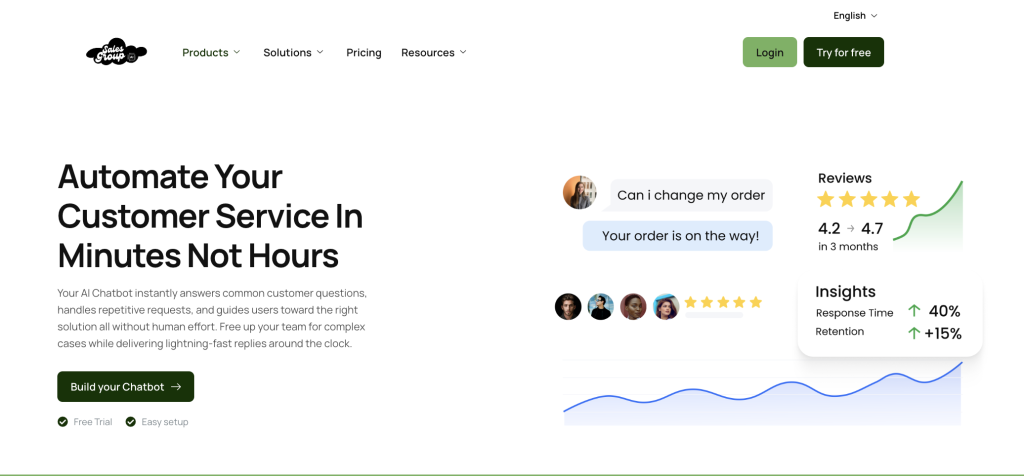
An AI chatbot is a software application designed to simulate human-like conversations through text or voice interactions. These systems use Natural Language Processing (NLP) and machine learning algorithms to understand user inputs and generate appropriate responses within a predefined scope.
Key Characteristics of AI Chatbots:
- Limited Scope Operation: Chatbots typically operate within a confined knowledge domain, focusing on specific products, services, or industries. For example, a car dealership’s chatbot can answer questions about vehicle specifications, pricing, and availability, but struggles with queries outside this domain.
- Pattern-Based Responses: Most chatbots use pattern matching or basic NLP to interpret user inputs and select appropriate responses from pre-programmed options. Even advanced AI chatbots with machine learning capabilities are generally constrained to their specific training data.
- Rule-Based Decision Trees: Traditional chatbots follow structured decision trees or scripts, making them predictable but inflexible when faced with novel situations or complex multi-step tasks.
- Reactive Nature: Chatbots primarily respond to user queries rather than proactively identifying and solving problems.
Real-World Chatbot Examples:
- Customer Service FAQs: Retail companies use chatbots to handle common questions about returns, shipping, and product availability
- Restaurant Reservations: Local restaurant chains deploy chatbots to manage table bookings by collecting basic information and checking availability
- Basic IT Support: Organizations use chatbots as first-line support for simple troubleshooting like password resets
Popular examples include Replika for emotional support conversations, Duolingo Max for language learning assistance, and H&M’s mobile app chatbot for product discovery and customer service.
What is an AI Agent?
An AI agent represents a more sophisticated artificial intelligence system capable of autonomous decision-making and complex task execution with minimal human guidance. These systems use advanced machine learning models, including deep learning and reinforcement learning, to process multi-modal data and adapt their behavior to achieve specific goals.
Key Characteristics of AI Agents:
- Autonomous Decision-Making: AI agents can analyze situations, make independent decisions, and execute multi-step plans without constant human oversight. They possess what researchers call “agency” – the ability to act purposefully toward goals.
- Contextual Understanding: Unlike chatbots that operate on pattern recognition, AI agents maintain context across interactions, understand nuanced instructions, and adapt their approach based on real-time feedback and changing conditions.
- Multi-Modal Capabilities: AI agents can process and integrate various types of input including text, voice, images, sensor data, and structured information from databases and APIs.
- Continuous Learning: These systems employ adaptive models that evolve with each interaction, using techniques like reinforcement learning to improve performance over time.
- Proactive Behavior: AI agents don’t just respond to queries; they can identify opportunities, suggest actions, and initiate workflows autonomously.
Real-World AI Agent Examples:
- Supply Chain Optimization: AI agents analyze sales data, inventory levels, supplier performance, and external factors to predict demand and automatically adjust order quantities
- Personalized Content Curation: Media companies use AI agents to continuously analyze user behavior and update content recommendations in real-time
- Career Development Assistance: Professional networks deploy AI agents to analyze job markets, provide resume feedback, and offer personalized career guidance
Advanced examples include HostAI for vacation rental management, MultiOn for complex web-based task automation, and Sender for decentralized finance operations.
Core Technical Differences
Architecture and Complexity
AI Chatbots typically employ simpler architectures:
- Single-layer processing focused on text understanding and response generation
- Limited memory systems that may not persist across sessions
- Static knowledge bases updated through manual intervention
- Rule-based or template-driven response systems
AI Agents utilize sophisticated multi-layered architectures:
- Perception Layer: Processes multiple input modalities (text, speech, vision, sensor data)
- Reasoning & Planning Layer: Employs logic engines, planning algorithms, and decision trees
- Memory & Context Management: Maintains both short-term and long-term memory with vector databases
- Communication Layer: Handles multi-modal interactions across platforms
- Action/Execution Layer: Performs tangible actions through APIs, browser automation, and system integrations
Learning and Adaptation Capabilities
Chatbots have limited learning capabilities:
- Static decision trees with periodic manual updates
- Basic machine learning for response selection within their domain
- Struggle with novel situations outside training data
- Learning is typically confined to improving existing response patterns
AI Agents demonstrate continuous learning:
- Reinforcement learning from user feedback and outcomes
- Transfer learning to apply knowledge across different domains
- Adaptive models that expand capabilities with use
- Real-time learning from environmental changes and new information
Task Complexity and Scope
Chatbots excel at:
- Answering frequently asked questions
- Guiding users through predefined processes
- Handling simple transactions or information retrieval
- Operating within narrow, well-defined domains
AI Agents handle complex scenarios:
- Multi-step workflow orchestration across platforms
- Dynamic problem-solving in ambiguous situations
- Integration of multiple data sources for decision-making
- Autonomous task execution spanning different systems and timeframes
Performance and Capability Comparison
| Aspect | AI Chatbot | AI Agent |
| Response Time | Fast (milliseconds) | Variable (seconds to minutes) |
| Task Complexity | Simple, single-step | Complex, multi-step |
| Learning Speed | Slow, requires retraining | Fast, continuous adaptation |
| Context Retention | Limited, session-based | Persistent, cross-session |
| Autonomy Level | Low, human-guided | High, self-directed |
| Integration Scope | Single platform/service | Multi-platform orchestration |
| Error Handling | Basic fallback responses | Sophisticated recovery strategies |
| Personalization | Template-based | Dynamic, behavior-driven |
Implementation Considerations
Technology Stack Requirements
Chatbot Implementation:
- Natural Language Processing libraries (spaCy, NLTK)
- Pre-trained language models (BERT, GPT-3.5)
- Simple database for conversation logs
- API integration for basic data retrieval
- Web framework for deployment (Flask, FastAPI)
AI Agent Implementation:
- Advanced ML frameworks (PyTorch, TensorFlow)
- Vector databases (Pinecone, Weaviate, FAISS)
- Orchestration platforms (LangChain, AutoGen, CrewAI)
- GPU infrastructure for model serving
- Complex memory management systems
- Multi-modal processing capabilities
Development and Maintenance
Chatbots are generally more straightforward to develop and maintain:
- Lower technical expertise requirements
- Faster development cycles
- Easier debugging and troubleshooting
- Predictable resource usage
- Simple deployment patterns
AI Agents require significant technical investment:
- Advanced expertise in machine learning and system architecture
- Longer development and testing cycles
- Complex debugging across multiple system components
- Variable resource requirements based on task complexity
- Sophisticated monitoring and observability needs
Cost Considerations
Chatbot Costs:
- Lower initial development investment
- Predictable operational costs
- Minimal infrastructure requirements
- Standard web hosting capabilities sufficient
AI Agent Costs:
- Higher upfront development costs
- Variable operational expenses based on usage
- Significant infrastructure investment (GPUs, specialized hardware)
- Ongoing costs for model training and updates
Industry Applications and Use Cases
Healthcare
Chatbots in Healthcare:
- Appointment scheduling and basic patient inquiries
- Symptom checking with predefined decision trees
- Medication reminders and basic health tips
- FAQ responses for common medical questions
AI Agents in Healthcare:
- Clinical diagnostic assistance with patient history analysis
- Automated clinical documentation and summarization
- Complex care coordination across multiple providers
- Real-time monitoring and alerting based on patient data patterns
According to recent studies, 42% of hospitals in the EU currently employ AI agents for disease diagnosis, with agents handling up to 95% of routine patient inquiries while enabling medical professionals to focus on complex cases. DigitalOcean
Financial Services
Chatbots in Finance:
- Balance inquiries and transaction history
- Basic investment information and product details
- Simple account management tasks
- Fraud alert notifications
AI Agents in Finance:
- Automated compliance monitoring and reporting
- Sophisticated fraud detection with pattern analysis
- Personalized investment strategy development
- Real-time risk assessment and portfolio optimization
McKinsey & Company reports that AI implementation in banking reduces fraud by 25% while increasing customer satisfaction by the same margin.
E-commerce
- Product search and basic recommendations
- Order status inquiries
- Return and shipping policy information
- Simple customer support escalation
AI Agents in E-commerce:
- Dynamic pricing optimization based on market conditions
- Complex supply chain management and inventory optimization
- Personalized shopping experiences with behavioral analysis
- Automated customer lifecycle management
Research shows that 63% of retailers use AI agents for personalized marketing and inventory tracking, with 65% of customer interactions successfully managed by AI-powered systems.
Security and Compliance Considerations
Data Privacy and Protection
Both chatbots and AI agents must comply with regulations like GDPR, HIPAA, and CCPA, but AI agents face additional challenges:
Chatbot Security:
- Simpler audit trails with limited data processing
- Easier to implement data retention policies
- Straightforward access control mechanisms
- Limited surface area for security vulnerabilities
AI Agent Security:
- Complex data flows across multiple systems requiring comprehensive auditing
- Advanced encryption needs for multi-modal data processing
- Sophisticated access control across autonomous operations
- Greater risk surface area requiring advanced security measures
Prompt Injection and Safety
AI agents face unique security risks including prompt injection attacks where malicious users attempt to manipulate the system’s behavior. Mitigation strategies include:
- Input sanitization and output validation
- Agent sandboxing with limited system access
- Command blacklisting for unsafe operations
- Human-in-the-loop verification for critical decisions
Future Outlook and Trends
Market Growth Projections
The AI agents market is experiencing exponential growth, with Grand View Research projecting the market to reach $50.31 billion by 2030, representing a compound annual growth rate (CAGR) of 45.8% from 2025 to 2030. This growth significantly outpaces traditional chatbot markets, indicating a clear industry shift toward more autonomous systems. Aalpha Information Systems
Technology Evolution
Emerging Trends:
- Multi-agent systems where specialized AI agents collaborate on complex tasks
- Integration with IoT devices and edge computing for real-time responsiveness
- Advanced reasoning capabilities approaching human-level decision-making
- Improved safety mechanisms and alignment with human values
Industry Predictions:
- By 2025, 85% of enterprises are expected to implement AI agents for various operations
- AI agents show potential to improve customer satisfaction by up to 120%
- Autonomous agents will become standard in supply chain, customer service, and content management
The Convergence Factor
The lines between chatbots and AI agents are becoming increasingly blurred as chatbot technology advances. Modern chatbots are incorporating agent-like features such as:
- Enhanced context awareness
- Integration with multiple external systems
- Proactive user engagement
- Limited autonomous task execution
However, true AI agents maintain distinct advantages in autonomy, learning capability, and complex problem-solving that position them as the future of intelligent automation.
Making the Right Choice: Decision Framework
When to Choose a Chatbot
Ideal Scenarios:
- Budget constraints require cost-effective solutions
- Simple, repetitive tasks with well-defined parameters
- High-volume, low-complexity customer interactions
- Quick deployment needs with minimal technical resources
- Predictable user interaction patterns
Success Indicators:
- Clear FAQ structures exist
- User queries follow predictable patterns
- Limited integration requirements
- Straightforward success metrics (response time, query resolution rate)
When to Choose an AI Agent
Ideal Scenarios:
- Complex, multi-step workflow automation needs
- Dynamic problem-solving requirements
- Integration across multiple platforms and data sources
- Proactive task identification and execution
- Personalization and adaptive behavior requirements
Success Indicators:
- Available technical expertise and resources
- Clear ROI expectations for complex automation
- Tolerance for longer development cycles
- Need for sophisticated analytics and continuous improvement
Hybrid Approaches
Many organizations successfully implement hybrid solutions where chatbots handle routine interactions while AI agents manage complex tasks. This approach offers:
- Cost optimization through appropriate technology matching
- Gradual migration path from simple to sophisticated automation
- Risk mitigation by testing advanced capabilities in controlled scenarios
- Scalable architecture that grows with organizational needs
Conclusion
The choice between AI agents and AI chatbots isn’t simply about selecting the more advanced technology—it’s about matching the right tool to your specific needs, resources, and objectives. While AI chatbots excel in handling straightforward, high-volume interactions with predictable patterns, AI agents shine in complex, dynamic environments requiring autonomous decision-making and multi-system integration.
Whether you’re looking to implement an AI chatbot for customer service or deploy an AI agent forcomplex business processes, Salesgroup offer both solutions to meet your diverse automation needs. SalesGroup combines the simplicity of AI chatbots with the advanced capabilities of AI agents, giving you the flexibility to scale your AI implementation as your business grows and evolves.
