
Gorgias vs Intercom: Which Ticketing Tool is Best for You
Both of these tools are excellent at helping businesses talk to their customers instantly, but they were built for two very different types of companies. Choosing the wrong one can be a very expensive mistake.
The rise of these two specialized platforms shows how complex customer service has become. It’s no longer enough to just answer an email; customers expect instant, personalized, and channel-specific help, whether they are shopping for shoes or fixing a piece of software.
This specialization has led Gorgias to focus entirely on fast-moving, high-volume retail transactions, while Intercom has dedicated its entire platform to guiding users through the complex journey of using a digital product.
Understanding this fundamental difference between “transactional speed” and “relationship guidance” is the key to mastering modern customer communication. Our thorough comparison will give you the specific details you need to align your messaging strategy with your business goals, ensuring you pick the tool that drives real revenue and customer happiness.
In this article, we will clearly break down what each platform does best, how their pricing works (since they are totally different), and give you a simple guide on how to choose the right one for your business. Let’s dive in.
What is Gorgias? The E-commerce Specialist
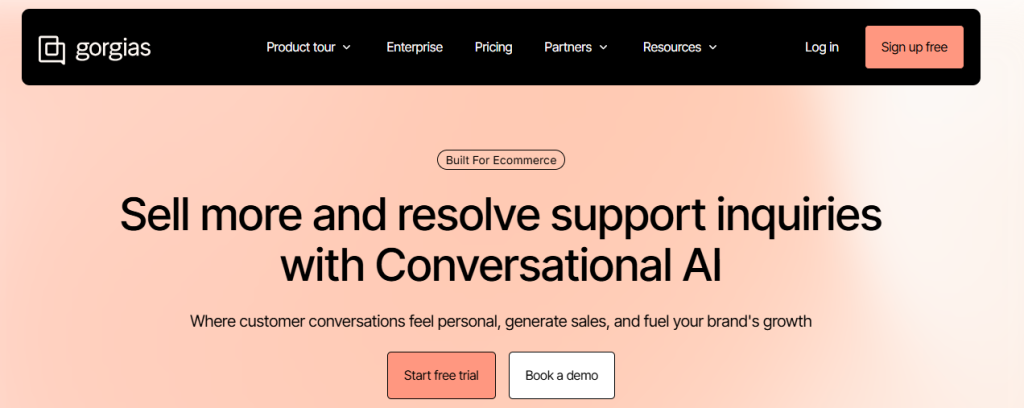
Gorgias is a help desk platform that was built specifically for e-commerce businesses, meaning companies that sell physical products online (like clothing, electronics, or home goods) through platforms like Shopify, Magento, and BigCommerce. Its entire purpose is to help online shops manage the huge volume of repetitive questions that come from shoppers.
Key Features of Gorgias
1. Deep E-commerce Integration:
This is Gorgias’s biggest strength. When a chat or email comes in, the agent instantly sees all the customer’s order details right next to the conversation—things like recent purchases, shipping status, and order value. They don’t have to leave the Gorgias screen to check Shopify.
2. Automated Actions (The Magic):
Because of this deep connection, Gorgias allows agents and bots to perform actions directly within the chat window. Agents can click a button to start a refund, cancel an order, or send a tracking number without ever logging into Shopify. This speed is critical for fast-moving online sales.
3. Ticket Volume Pricing:
Gorgias charges based on the number of billable support tickets (or conversations) you handle per month. This means you pay based on how busy your customer service team is, not how many agents you have.
4. Omnichannel Support:
It brings in messages from all key e-commerce channels: live chat, email, Facebook Messenger, Instagram DMs (Direct Messages), and SMS texts, unifying them all into one simple workspace.
What is Intercom?
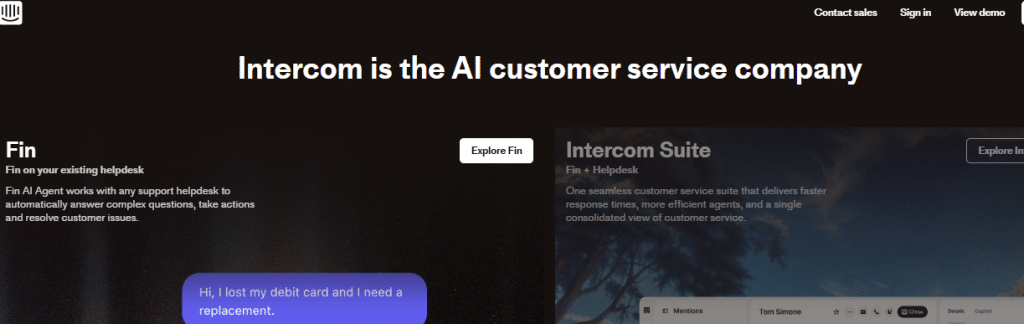
Intercom is an industry-leading platform that focuses on Conversational Relationship Management (CRM), primarily built for SaaS (Software as a Service) companies, tech firms, and businesses that need to talk to users inside their web or mobile application. Its goal is to handle support while also driving product engagement and growth.
Key Features of Intercom
1. In-App Messaging and Onboarding:
Intercom excels at putting its chat widget right inside your product or mobile app. This allows your team to send proactive, targeted messages to users based on what they are doing in the app (e.g., “Welcome to the dashboard!” or “Need help setting up your first project?”).
2. Fin AI (The Smart Bot):
Intercom’s powerful AI bot, Fin, learns from your knowledge base and conversation history. It provides instant, human-like answers and is focused on resolving issues automatically.
3. Product Tours and Guides:
Intercom can be used to build step-by-step guides and “product tours” that walk users through new features, which is essential for user adoption in tech products.
4. Seat and Contact Pricing:
Intercom’s pricing is usually based on two main things: the number of full agent seats (how many human agents you have) and the number of active contacts (how many users you talk to each month).
Price Comparison; Gorgias vs Intercom
Gorgias and Intercom have fundamentally different pricing structures, and understanding this difference is the most critical factor when making a choice.
Gorgias: Pay for Volume (Tickets)
Gorgias uses a usage-based model focused on billable tickets or conversations.
Pro: If you have high chat volume but only a few agents, Gorgias can be very cost-effective. You can have many agents jump in to help with high volumes without increasing your bill, as long as you stay within your conversation limit.
Con: If your support volume explodes one month (say, during a holiday sale), your bill can suddenly be much higher because you exceeded your pre-paid ticket limit. The cost is less predictable.
For e-commerce stores, support volume is not constant. It spikes massively during holidays like Christmas, Black Friday, or flash sales. If you are on a Gorgias plan that allows 3,000 conversations and you suddenly handle 6,000 in December, you will be charged an expensive overage fee for the extra 3,000 conversations. This makes budgeting during peak seasons a potential risk.
Gorgias Pricing Tiers (Approximate Annual Cost)
| Plan Name | Billable Tickets Included | Key Feature | Approximate Annual Price |
|---|---|---|---|
| Basic | 200 tickets | Live Chat, Email | ~$60/month |
| Pro | 3,000 tickets | All Channels, Automated Rules | ~$360/month |
| Advanced | 6,000 tickets | Advanced Customization, AI | ~$900/month |
| Enterprise | Custom volume | Custom Integrations, Dedicated Manager | Custom |
Intercom: Pay for People (Seats)
Intercom primarily uses a seat-based model (paying per agent who logs in) that often scales with your contact volume.
- Pro: Costs are usually more predictable month-to-month based on the size of your team. You know exactly what you pay per agent seat.
- Con: If you have a huge number of customers (contacts) or need to add just a few more agents, your bill can get very complex and quickly become very expensive as you move into higher contact tiers or add features like the Fin AI or Product Tours.
Intercom’s pricing can be tricky because you often pay twice: once for the human agent seat, and once for the number of active users (contacts) the platform manages. If your SaaS product has millions of free users, but you only talk to a few thousand of them each month, you still have to manage that large database of contacts, which can quickly drive up your monthly cost into the thousands, regardless of your team size.
Intercom Pricing Tiers (Approximate Annual Cost – Billed Per Seat)
| Plan Name | Seats/Contacts | Key Feature | Approximate Annual Price (Per Seat) |
|---|---|---|---|
| Essential | 1 seat, 1,000 contacts | Live Chat, Help Center | ~$39/seat/month |
| Advanced | 1 seat, 2,000 contacts | Fin AI, Advanced Automation | ~$99/seat/month |
| Expert | Custom seats/contacts | SSO, Service Level Agreements (SLAs) | ~$150/seat/month |
| Fin AI Add-on | N/A (Resolution Based) | Charged extra per automated resolution | ~$0.99 per resolution |
How to Choose: E-commerce vs. SaaS
Choosing between Gorgias and Intercom comes down to answering one simple question about your business model.
Choose Gorgias If:
1. You are an E-commerce Store: Your main product is physical goods sold on Shopify, Magento, or similar platforms.
2. You Need Order Actions: Your agents spend all day checking order status, processing returns, and canceling orders. Gorgias will save your agents many hours by letting them do this with one click inside the chat.
3. Your Volume is High: You handle thousands of repetitive questions (like “Where is my package?”) and want the AI to automate those simple tasks to keep your small human team free for harder problems.
Choose Intercom If:
1. You are a SaaS or Tech Company: Your product is software, and your users spend most of their time inside a web or mobile application.
2. You Need Engagement: You want to use the chat tool for more than just support, like sending targeted product announcements, onboarding new users, or showing guided tours.
3. You Need In-App Support: You want your users to be able to get help without leaving your product, keeping them focused on their work and improving feature adoption.
Conclusion
Gorgias and Intercom are both fantastic tools that have created great success for the companies they were built for. Gorgias dominates the e-commerce support world by specializing in order management, while Intercom leads the software engagement space by mastering in-app messaging and user onboarding.
However, both of these platforms are built to solve only part of the business problem. Gorgias focuses on Service, and Intercom focuses on Engagement. Neither tool is designed to manage the entire sales pipeline, marketing budget, and service tickets all in one seamless, high-level system.
This is why Salesgroup stands as the ultimate alternative to both. Salesgroup is a complete, enterprise-level platform that unifies all customer data and activity. It doesn’t just manage chats; it manages the entire sales deal, marketing history, and service case file from a single place.
If your business grows to the point where you need all your customer interactions—from the first marketing email to the final support resolution—to contribute directly to a single, measurable sales and revenue strategy, moving to a powerful, fully integrated Salesgroup platform will be the necessary next step.
